
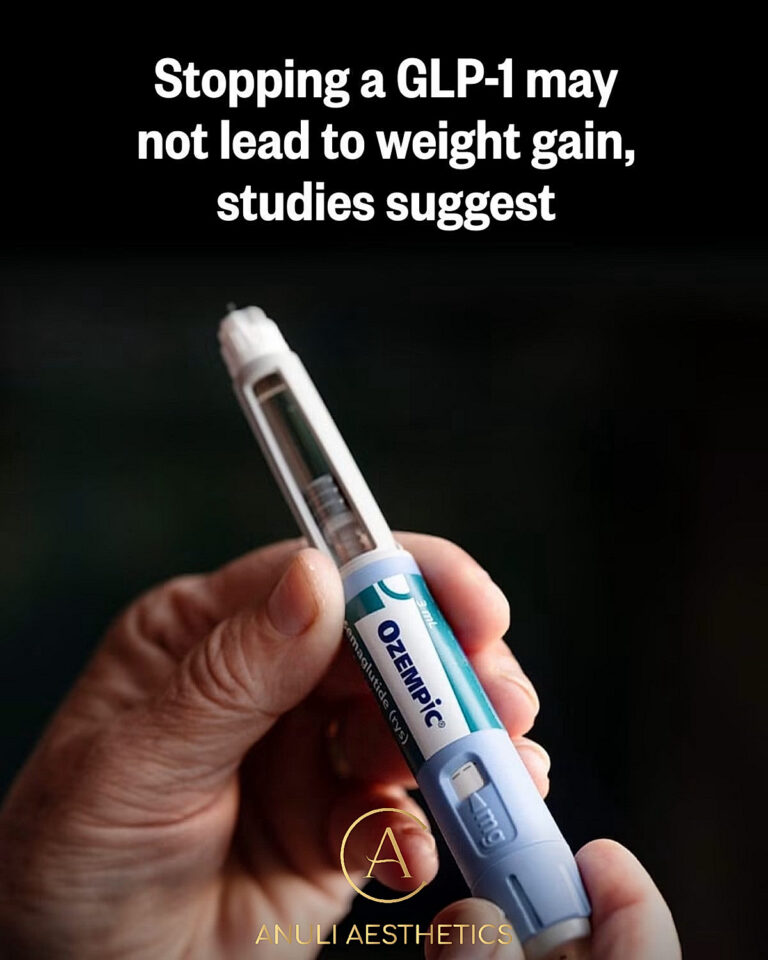
If you’ve been on Ozempic, Wegovy, Mounjaro, or Zepbound, aka GLP-1, you’ve probably heard the scary version aboutn what happens when you stop: “You’ll gain it all back.” That’s the headline that’s been circulating for a while, based largely on controlled clinical trials where patients had little to no support after discontinuation.
But real-world data just told a different, more hopeful story — and it lines up exactly with what I’ve lived and what I teach every day at Anuli Aesthetics & Wellness here in Houston.
What the New Study Actually Found
A large real-world study out of the Cleveland Clinic, covered in depth by Medical News Today, followed nearly 8,000 adults who started injectable semaglutide or tirzepatide and then stopped within 3 to 12 months. Researchers tracked what happened to their weight over the following year. The results push back on the “you’re doomed to regain it” narrative:
- Before stopping, people treated for obesity lost an average of 8.4% of their body weight. People treated for type 2 diabetes lost an average of 4.4%.
- One year after stopping, the obesity group regained just 0.5% of body weight on average — a small fraction of what they’d lost. The diabetes group didn’t regain at all; on average, they lost an additional 1.3%.
- Nearly half kept it off or kept losing. In the obesity group, 45% maintained or continued losing weight after stopping. In the diabetes group, that number was 56%.
That’s a dramatically different picture than the clinical-trial headlines suggested — and the reason behind the difference matters more than the number itself.
The Real Reason People Kept the Weight Off
Here’s the detail buried in the study that changes everything: most of the people who kept the weight off didn’t just stop and hope for the best. Within a year of discontinuing their original medication, researchers found:
- 27% switched to another obesity medication
- 20% restarted their original GLP-1
- 14% shifted into structured lifestyle support — working with dietitians, exercise specialists, or a coordinated wellness program
- A small number pursued bariatric surgery
In other words: the people who kept their results weren’t relying on the medication alone, or on willpower alone. They were relying on a plan that continued after the prescription stopped. The study’s lead researcher, Dr. Hamlet Gasoyan of the Cleveland Clinic, put it plainly — patients who stop a GLP-1 have real alternatives, and the conversation with their care team about what comes next is what determines the outcome.
I want to sit on that third bullet for a second, because it’s the one that matters most to me: 14% of patients kept their results by moving into structured lifestyle intervention — working with dietitians, exercise specialists, or a coordinated wellness program instead of, or alongside, restarting medication.
That’s not a footnote. That’s the entire model. That “lifestyle intervention” arm of the study isn’t some vague concept — it’s a dietitian appointment, a strength-training plan, a coach checking in on you, a nutrition strategy built for real life. It’s exactly what a program like the one I built at Anuli is. The people in that 14% weren’t doing anything mysterious. They were doing what I did three years ago, and what I still do today.
That single insight is the entire thesis of how I approach weight loss — because I lived it.
Why This Isn’t Surprising to Me
Three years ago, I lost 100 pounds. I’ve kept every pound of it off since. I didn’t do it by finding a shortcut and walking away once the number on the scale hit my goal. I did it by building an infrastructure around myself — nutrition literacy, strength training, accountability, and a plan for the moments when motivation wasn’t enough — and I never stopped using it.
What this new data confirms in clinical language is something I already knew from experience: the medication, the diet, the initial push — that’s just the entry point. What happens after is a completely different phase, and it requires a completely different plan. The good news researchers are now proving is that this phase is very winnable. It just isn’t automatic.
What Actually Keeps the Weight Off (With or Without a GLP-1)
Based on this research and what I’ve built at Anuli, here’s what separates the people who become part of that 45–56% from the people who don’t:
- A transition plan, not a stop date. The data is clear — people who kept results either adjusted their medication strategy or moved into structured lifestyle support. Nobody in the “success” group just stopped cold with no follow-up plan.
- Strength training to protect metabolism. Preserving lean muscle mass matters more after the medication than during it, since appetite suppression is no longer doing part of the work for you.
- Real coaching and accountability. This is that same 14% — the group that went into structured lifestyle support instead of leaving their results to chance. It’s exactly the role Anuli plays for our patients, whether they’re on a GLP-1, coming off one, or never plan to start one.
- Addressing why you eat, not just what you eat. Appetite suppression fades. The habits and emotional patterns underneath it don’t disappear on their own.
- A proactive conversation with your care team before you stop, not after. The patients in this study who did best made a plan for the transition in advance.
GLP-1s Are a Legitimate Tool — And So Is What Comes Next
None of this is an argument against GLP-1 medications. They’re genuinely effective, and for many patients they’re the reason they finally got real traction. The data doesn’t say the drugs failed people — it says the people who built a plan for after the drug did far better than the ones who didn’t.
That’s the exact gap I built my approach around. Whether someone walks into Anuli already on a GLP-1, thinking about starting one, or getting ready to come off one, the conversation is the same: the medication can get you started. The plan is what keeps you there.
The Bottom Line
The newest, most realistic data we have says you don’t have to accept weight regain as inevitable. Nearly half of real-world patients kept their results a full year after stopping — and the common thread was a continued, structured plan, not luck. I built my life around proving that’s possible, and I built Anuli Aesthetics & Wellness to help other people do the same.
Ready to build a weight loss plan that’s designed to last — whether you’re starting a GLP-1, coming off one, or skipping medication altogether? Book a consultation with Anuli Aesthetics & Wellness and let’s map out what comes next.
Anuli Aesthetics & Wellness | Not Just a Clinic. A Concierge. | Houston, TX